Agile isn't dead. It's running on assumptions AI already broke.
Agile's values still hold, but many of its ceremonies were designed for a time when human effort was the bottleneck and feedback had to wait for a meeting. Now that AI has sped up how fast features get built, rituals like the sprint-end demo are turning into process kept alive for the organization rather than for the work. The practical fix is to name the assumption behind each ceremony and check whether it is still true.
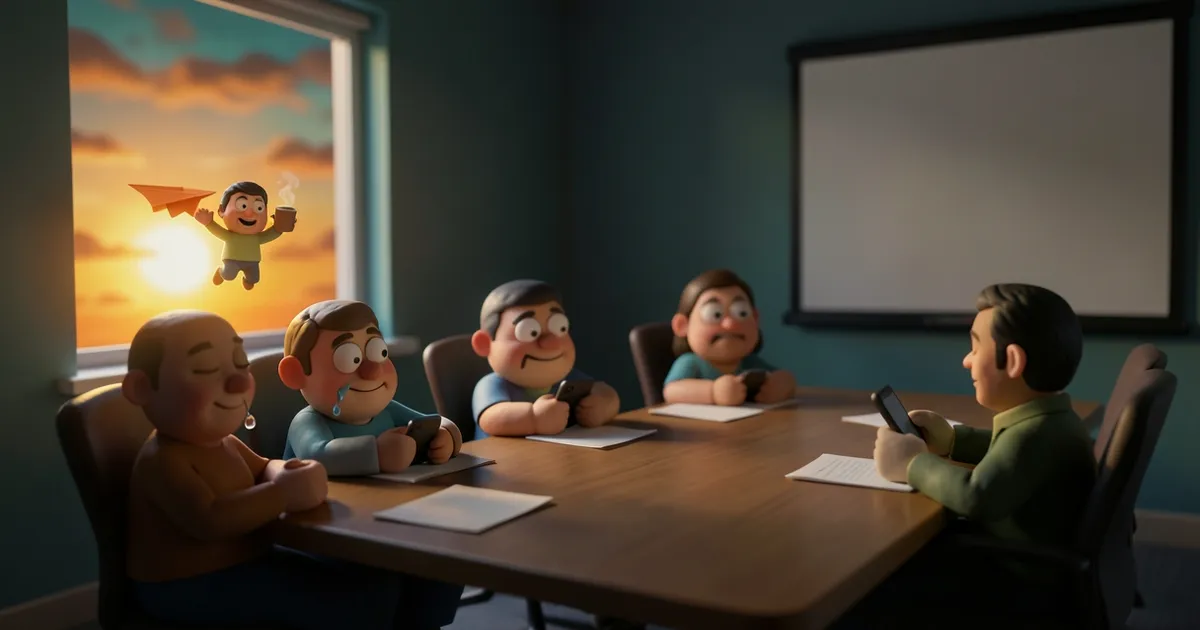
For years, the sprint demo was the one meeting I never wanted to miss. Every three weeks the team got in front of product and showed what they had built. It was the moment of truth. If we had misunderstood something, this is where it came out, and waiting three weeks to find out had a real price.
Then the pace changed. Features that used to fill a sprint started landing in a few days. Waiting for the end of the sprint to show them made no sense anymore, so we stopped waiting. We started working much closer with product and showing each piece the moment it was ready.
The demo didn’t vanish overnight. It turned into a recap of things product had already seen and already commented on. We still hold it, because the organization around us still expects it on the calendar, and organizations change slower than code does. But nobody in that room thinks it is where the work happens. The work itself went async. The meeting is there for the process, and I expect it to disappear completely, because the pace no longer leaves room for it.
That is what I mean when I say Agile isn’t dead. Nobody killed the demo. It existed because showing work was expensive: you had to get a feature stable enough to show and get the right people into one room, and batching that every few weeks was the cheapest way to get real feedback. Once showing became cheap, the reason for the batch expired, and the ceremony kept running on habit.
Almost every Agile ceremony rests on an assumption like that. The daily standup assumes you can’t see what your teammates did yesterday without asking them. The sprint assumes a meaningful chunk of work takes about two weeks. Story points assume that complexity predicts effort. In 2026 all of those are shaky. The board and an AI summary of yesterday’s commits answer the standup question before anyone speaks. An agent can finish in an afternoon a task the team estimated at eight points, and once that happens a few times, the velocity number stops describing anything.
The values are fine. I would argue they matter more now. Working closely with the customer and responding to change become more important when you can build faster, because building the wrong thing has also become faster, and it is now very easy to build a lot of it.
What’s breaking is the scaffolding we built around those values. Agile was designed to get the most out of human throughput at a time when human effort was the scarcest resource in the building. AI moved that constraint. The ceremonies didn’t get the memo.
So what do you do with a meeting that everyone privately knows is theater?
Cancelling everything on Monday is not the answer. Some ceremonies still earn their slot, and pulling out a structure before the people around you are ready for it creates a different kind of mess. It is also harder than it sounds: most teams would rather sit through one more meeting than have the conversation about removing it, because cancelling a ceremony can look like skipping the process. I don’t consider it a failure that our demo still exists. A ceremony can be a useful bridge while the rest of the organization catches up.
The failure is pretending the bridge is the destination. Once a meeting is openly “for the process,” it needs an end date and an owner, or it will outlive everyone who remembers why it started.
The method is simple and a little uncomfortable. For each recurring ceremony, ask what problem it was built to solve, and whether that problem still exists in the same form. If it does, keep the meeting and protect it. If it doesn’t, say so out loud, in the room, and decide together what replaces it. Usually the answer is not a better meeting. It is a signal the team can see without meeting at all: a pull request waiting too long, a build that keeps failing, a feature shipped to a small group of users with numbers attached.
This is the same pattern I wrote about in AI made your team write code faster. Your delivery didn’t notice. The tools changed the speed of one part of the system. The rest of the system is still shaped for the old speed, and the gap shows up wherever nobody has looked yet.
One thing to try tomorrow: list your team’s recurring meetings, and next to each one write a single line: the assumption it depends on. Then ask the team one question per line: is this still true? There is usually one meeting where everyone quietly agrees the answer is no. Start there.
REDEFINE goes through seven of these structural flaws in detail, including what I think Agile should keep and what it should let go. Read REDEFINE.
Related: AI made your team write code faster. Your delivery didn’t notice. · The metric you use to judge people is the reason your data lies · I run a squad of AI agents. Here is what the work actually looks like.